Showing posts with label Court Cases. Show all posts

Sunday, April 24, 2011

New York Times Co. v. United States

The Vietnam War gave rise to a massive amount of public protest. Daniel Ellsberg, who was opposed to the war, worked as a political scientist for the pentagon. in 1971 he stole and copied a classified paper which would later be known as the pentagon papers. He turned these classified documents over to the New York Times, who began publishing them. On june 15, the federal government was granted an order stopping the Times from publishing the papers. The case was appealed to the United States Supreme Court inn a matter of days, raising the question of weather its publication was a matter of national security. The courts 6 to 3 decision was issued per curiam. Justice Black wrote, " the press was protected so that it could bare the secrets of government and inform the  people". I agree with the courts decsion on this case, although my opinion may change depending on the documents being released. I believe the people should have the right to see these documents, and understand what its government is doing.
Read more here

Gitlow v. New York

Benjamin Gitlow was convicted for violating the 1902 New York Criminal Anarchy Act. He was charged as a result of two publications, advocating "mass industrial revolts". He argued that the first amendment incorporated under the due process clause of the fourteenth amendment protected him. The United States Supreme Court found him guilty, in a 7 to 2 vote. Justice Edward Sanford concluded that "utterances advocating the overthrow of organized government by force, violence, and unlawful means" are unlawful.
I agree with the court decision on this case because someone advocating the overthrow of our government is a threat to the peace and well being of our country and people. Read more here

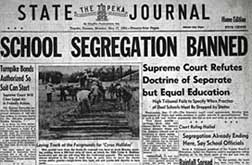
Brown v. Board of Education of Topeka, Kansas

Brown represented a collection of cases, all tied together in that black children had been denied admission to segregated white public schools. This case brought up the previous decision of Plessy v. Furguson, questioned weather separate but equal was constitutional. The court decided unanimously in favor of Brown. Chief Justice Warren decided that segregating schools " has a tendency to retard the educational and mental development of negro children and to deprive them of some of the benefits they would receive in a racially integrated school system". He concluded that separate but equal has no place in the field of education. I completely agree with the courts decision on this case. I believe everyone should have the equal right to a good education.
Read more about the case

Gideon v. Wainwright

in 1963, Clarence Earl Gideon was arrested for breaking in with intention to burglarize.  At his trial, he was refused a court appointed attorney, because the state of Florida did not provide attorneys for capital cases. Conducting his own defense, Gideon was sentenced to five years imprisonment. From prison, Gideon wrote a hand written petition requesting an appeal from the United States Supreme Court. His case was accepted by the court to examine the decision in Betts v. Brady, which established that council was not appointed for capital cases. The court decided in his favor, establishing that "any person haled into court, who is too poor to hire a lawyer, cannot be assured a fair trial unless counsel is provided for him". I completely agree with the courts decision to overturn the decision in Betts v. Brady. I find it shocking how they could expect someone with no previous experience to defend themselves properly in a court of law without any representation.

Miranda v. Arizona

The Miranda decision was compiled from four similar cases with the same constitutional issue. In the main case, Ernesto Miranda was arrested in Phoenix, Arizona on charges of kidnapping and rape. After a long interrogation, he finally signed a written confession and was later found guilty. Miranda appealed to the United States Supreme Court, stating his fifth amendment right was violated: he should not be compelled to be a witness against himself. In a 5 to 4 split vote, the Supreme Court decided to overturn Miranda's conviction, claiming there must be procedural safeguards in order to protect the accused. I believe the court made the right decision on this case. Everyone accused of a crime must be read and aware their rights, and have an opportunity to be rightfully protected in an interrogation.
Read more on the case

Regents of the University of California v. Bakke

In 1973, the University of California at Davis used separate admissions process for minority students. When Alan Bakke was refused admission, with a science grade point average slightly lower than average and a high aptitude test score, he sued the Regents for a place at the medical school. After the California Supreme Court decided in his favor, and ordered him admitted to the medical school, the Regents appealed to the United States Supreme Court.  After two separate 5 to 4 votes and majorities, the court ruled that the special admissions criteria for minority students violated the fourteenth amendment. The court decided that the Universities admission process imposed disadvantages to some, such as Bakke. I believe the court made the right decision. I feel that college admissions are a very important part of our modern society, and that everyone should have an equal opportunity to be accepted.
Read more about the case

Miller v. California

Miller was prosecuted for mailing out large numbers of sexually explicit brochures. The court voted in favor of California in a close 5 to 4 split. His case was appealed to the United States Supreme Court because he believed the first amendment guaranteed his right of free speech and free press. This being one of the first cases of its time, there were few regulations and standards for what could be released to the public. The courts decided to propose three new guidelines for offensive material, as well as leaving the determination of actual tests to local powers.  I believe this was the correct decision for the court to make. I was surprised by the 5-4 split, but I believe those justices were just standing up for the first amendment.
More on the case

Plessy v. Furguson

In 1890, Louisiana law required the railroads to "provide equal but separate accommodations for the white and colored races". The case of Plessy v. Furguson was centralized around this issue: Plessy, who was one eighth black, refused to move from the white section of the train, forcing law enforcement to arrest him. After losing his state court case, it was appealed to the United States Supreme. Plessy claimed his case was a violation of the thirteenth and fourteenth amendments. The courts ruled 7-1, with one member absent, that Plessy was guilty. I believe this was a result of the struggle between races during that time period. Many people in the south still had an influence from slavery that clouded their judgement. I think it was very courageous of the one judge, Justice John Harlan to stand up for what he believed in, and not support racism. 

Tuesday, April 19, 2011

United States v. Nixon

During President Nixon's 1974 reelection campaign, burglars broke into the Democratic National Committee who had alleged ties with the president. This led to a private investigation with a special prosecutor who would attempt to subpoena some private conversations from the oval office. The President was forced to turn over the tapes after a unanimous decision by the supreme court decided he did not have the executive privilege to refuse. I completely agree with the courts decision and believe that the president should not have the right to hide the tapes. The court found that the Presidents claims that the documents were confidential and that the principle of separation of powers was not enough to win the argument.

Monday, April 18, 2011

Roe v. Wade

While the sate does have the peoples safety and best interest in mind, the government must follow the rules of the constitution. In the case of abortions, the government does want to protect the unborn child, but also must look out for the best interest of the parent. In the case of Roe v. Wade, Jane Roe made the case to a Texas judge that a fetus was not a person  in the eyes of the law, and therefor she should have the right to an abortion, and that her decision to get an abortion  should be protected by the right of privacy.